cookwithjoy482@gmail.com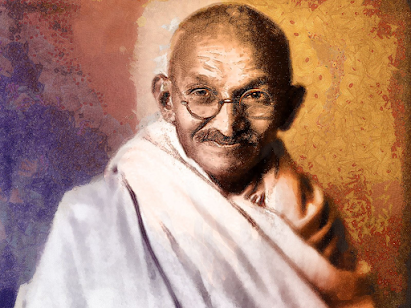
Mahatma Gandhi (Father of Our Nation)
Introduction –
Mahatma Gandhi’s name is on the lips of everyone. He was the father of the nation. He was a deeply religious man. He taught and practised truth. He was a great leader, a saint, a great freedom fighter, and a great social reformer. He believes in simple living and high thinking. We generally call him “Bapu”. He followed the path of truth and Ahinsa.
His full name is Mohandas Karamchand Gandhi. He was born at Porbandar in Kathiawar on 2nd October in 1869. His father, Sri Karamchand Gandhi, was the Diwan of Rajkot. His mother, Putlibai, was a novel and pious lady. During his childhood, Gandhi was deeply influenced by his mother’s nature. Mahatma Gandhi was married at the very young age of 13 to Kasturba Makhanji.
His birthday is celebrated as Gandhi Jayanti throughout India. Gandhiji wrote his famous autobiography under the title “My Experiments with Truth.
His Education-
At the age of seven, he was sent to school. At the school, he proved himself to be only an average student. He was always regular and punctual in his class. After passing his matriculation examination, he studied at college. He graduated with a degree in law from the University of Bombay. Soon after, he got admission into the University of London. He graduated from the University of London in 1891 and appeared in England’s bar exam.
Then he returned to Bombay and started his practice at Bombay, but he did not do well. He was not a successful lawyer. After that, he went to Africa to conduct a big lawsuit in a court. There he saw the bad condition of the Indians. He put up a brave fight for their rights. He founded the Natal Indian Congress. He was jailed with his friends. In 1914, the Indian Relief Act was passed. This bettered the lot of Indians.
His political work in India-
Gandhiji returned to Bombay in January 1915 and spent the next 3 years hovering on the boundary of Indian politics. He declined to join any imminent political agitation. In February 1919, the British pushed through the Indian opposition with the Rowlatt Act. As a result, Gandhiji announced a Satyagrah struggle that proved to be a virtual political earthquake.
By 1920, Gandhiji was a dominant political figure commanding an influence that India had never experienced before.
On 10 March, 1922, Britishers arrested Gandhiji for sedition with a sentence of 6 years. He began the Civil Disobedience Movement in 1930. It was a practice that involved refusing to obey any order or law that was oppressive.
The Quit India movement was the greatest success, with all the Indians protesting united under the guidance of Gandhiji. This was the last movement against the British, and they were forced to leave India. Thus, India achieved independence on 15 August, 1947.
Mahatma Gandhi played an important role not only in India’s Freedom struggle but also in bringing positive social change. He worked hard to remove social evils and improve society.
His Death-
Gandhiji always stood for communal harmony, but he himself was shot dead by a religious fanatic, Nathuram Godse, a Hindu activist, on 30th January, 1948.
Conclusion–
Gandhiji was a great teacher, preacher, thinker, and soldier. He will be remembered and respected by the word for ever. The finest tribute paid to him was from General Smute, who called him “a prince among men.” He fought for the rights of the poor and untouchables. He used the spinning wheel (Charkha) as a symbol of self-reliance.